
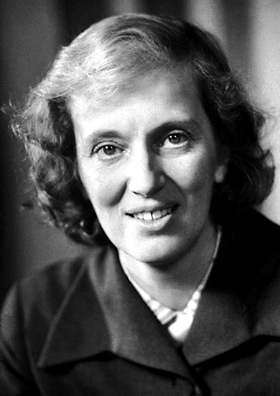
Dorothy Crowfoot Hodgkin (1910-1994) was a distinguished English chemist and Nobel Prize laureate who utilized X-ray crystallography to determine structures of biomolecules, including penicillin and vitamin B-12. From a young age, Dorothy expressed a fascination with crystals, a passion she described as being “captured by crystals.” Her life story is unique due to her upbringing and chronic health condition—she endured rheumatoid arthritis from the age of 24. She is featured as the 26th installment in our “Women in Nuclear History” series.
- Dorothy Mary Crowfoot was born in Cairo, Egypt, as the eldest of four daughters. Her parents, John Winter Crowfoot and Grace Mary (née Hood), were archeologists. During their parents’ expeditions in Africa and the Middle East, she and her sisters spent most of their childhood with their grandparents in Great Britain.
- Dorothy’s adventure with science began in elementary school when she observed the growth of crystals. In 1921, her father enrolled her in the Grammar School in Beccles, England, where she was one of only two girls granted permission to study chemistry.
- On her 16th birthday, her mother gifted her a book by W. H. Bragg on X-ray crystallography. In 1928, her parents took her to various archaeological sites in Jordan to study Byzantine-era Church mosaics, and she documented the patterns through photography and chemical analyses.
- At the age of 18, Hodgkin enrolled in Somerville College, Oxford to study chemistry and graduated with honors in 1932. Shortly thereafter, she began her PhD at Cambridge under the guidance of John D. Bernal using X-ray crystallography to investigate protein structures, completing her doctoral studies in 1937. During this period, she also taught chemistry, mentoring students such as Margaret Roberts Thatcher, who later became Prime Minister of Great Britain.
- In 1934, at 24, Dorothy started to experience pain and swelling in her hands, leading to a diagnosis of rheumatoid arthritis. This condition necessitated adjustments to her workspace, particularly with the X-ray equipment. Despite eventually requiring a wheelchair, she persevered in her scientific pursuits.
- In 1937, Dorothy Crowfoot married Thomas Lionel Hodgkin, a teacher and social activist, with whom she had three children. The couple shared progressive views on social inequalities and the risks associated with the development of long-term nuclear weapons.
- In 1945, Hodgkin, along with her colleagues including biochemist Barbara Low, successfully determined the structure of penicillin. Subsequently, she solved the complex structure of vitamin B12, after finding how cobalt would modify its geometry. She was able to characterize fully its structure by using X-ray techniques.
- Hodgkin’s findings regarding vitamin B12 were published in 1958, leading to her Nobel Prize in Chemistry in 1964, making her the first British woman scientist to receive a Nobel Prize.
- Over a span of 35 years, she dedicated herself to determining the structure of insulin, achieving a complete resolution in 1969 through collaboration with a team of researchers and the advances in X-ray technology.
- Dorothy Crowfoot Hodgkin passed away in July 1994 after suffering a stroke at her husband’s residence in Ilmington. In 2022, the Department of Biochemistry at Oxford honored her legacy by renaming its expanded facility the “Dorothy Crowfoot Hodgkin Building.”
References:
https://en.wikipedia.org/wiki/Dorothy_Hodgkin
https://mbb.yale.edu/news/honoring-womens-history-month-dorothy-crowfoot-hodgkin
https://www.nobelprize.org/prizes/chemistry/1964/hodgkin/biographical/