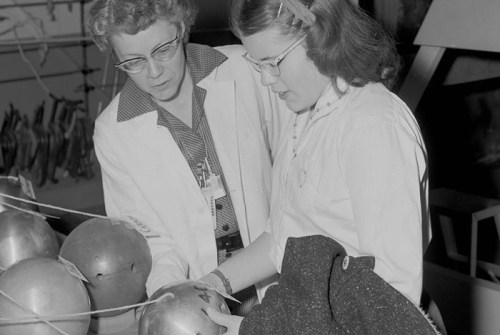
Elizabeth “Diz” Riddle Graves (1916-1972) was an American physicist, one of the few women physicists that contributed to the Manhattan project. Her life is so interesting that it deserves a movie. She is the 20th installment of our Women in Nuclear series.
- Elizabeth “Diz” Riddle Graves was born on January 23, 1916 in Nashville, Tennessee to James Marion and Georgia Clymetria Boykin. She had two brothers. The family moved to Chicago in 1921.
- In 1936, she earned a Bachelor of Science degree in physics from the Chicago University where she developed a keen interest in neutrons physics and their detection.
- During her studies she met her husband, physicist Alvin Graves, who was conducting neutron-scattering experiments. They started working together.
- In 1939, Alvin took a position at the University of Texas, but Elizabeth was unable to get a job there due to its anti-nepotism rules, which discriminated against women, who were wives of male researchers.
- In 1940, Diz earned her PhD at the University of Chicago with the thesis: “Energy Released from Be9 (d, α) Li7 and the Production of Li7” — this was a very important contribution to the understanding of reactions physics.
- Arvin and Diz joined the Manhattan project at the Los Alamos Laboratory. Diz was involved in fast neutron scattering, which was crucial to nuclear weapons design. Colleagues described her as a “very” hard worker and someone who was “very good at her job,” while also an independent thinker and having a sense of humor.
- During the Trinity nuclear test (first nuclear atomic bomb test), Arvin and Diz requested to be assigned to the post further away from the blast since Diz was seven months pregnant with their first child. They drove to a cabin approximately 35 miles east of the Trinity test site and measured the magnitude of the explosion with Geiger counters and monitored the radioactive fallout.
- In 1946, Alvin was in the room with Louis Slotin, who accidentally caused a deadly accident with a plutonium sphere reaching criticality, the so called “demon core.” Slotin died after receiving an acute dose of radiation, Alvin survived but was left with chronic neurological and vision problems.
- In 1950, Elizabeth Graves became a group leader in the experimental physics division at Los Alamos, and researched neutron interactions with matter and material.
- Elizabeth Graves died of cancer at age 55 on January 6, 1972. She was buried at Guaje Pines Cemetery, Los Alamos, NM. Alvin had died in 1965 of a heart attack while skiing. They had altogether three children.