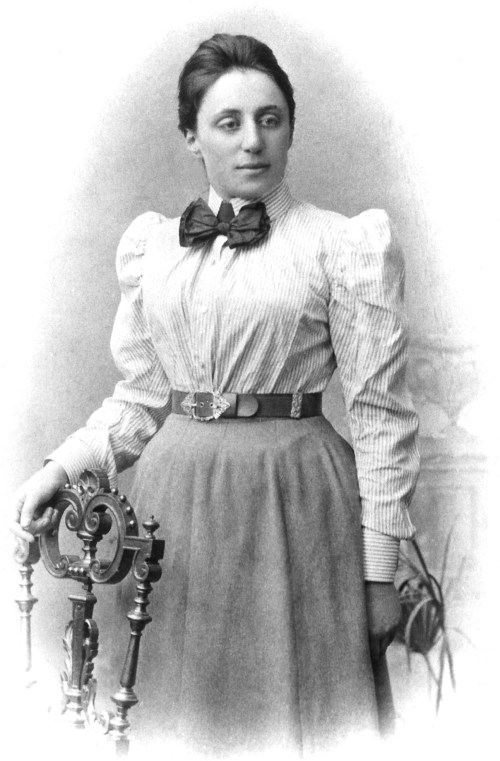
Women in Nuclear History” series #24 – Emmy Noether – brilliant Mathematician that helped Einstein Relativity Theory
Emmy Noether (1882 – 1935) was a German mathematician of Jewish origin who is considered the most significant woman in mathematics. She made important contributions to abstract algebra, invariants, group theory, symmetry of physical system and conservation laws that apply to physical forces and Einstein’s general relativity theory. She is our #24 installment in “Women in Nuclear History.”
- Noether was born as Amalie Emmy on March 23, 1882 in Erlangen, Germany as the eldest and the only daughter to Max and Ida Amalia Kaufmann. Her father, Max Noether, was a renowned mathematician.
- Since she was a woman, she considered becoming just a language teacher (French and English), but her passion of science prevailed. Emmy was allowed to audit classes at the University of Erlangen, depending on whether individual professors agreed. Despite these obstacles, she passed the graduation exam with excellence in 1903.
- Afterwards Noether went to study at the University of Göttingen attending lectures by Karl Schwarzschild – famous astronomer, and famous mathematicians: Hermann Minkowski, Felix Klein and David Hilbert. When the restrictions against women’s full enrollment were rescinded in Bavaria, she returned to Erlangen and graduated summa cum laude with a Ph.D. thesis related to invariant systems in 1907.
- Between 1908 and 1915, Noether taught at Erlangen’s Mathematical Institute without pay, occasionally substituting for her father and published several papers. In 1915, Noether was invited back to the University of Göttingen by David Hilbert and Felix Klein in spite of resistance from other faculty. During her stay, she proved a theorem (called Noether theorem after her presently) that a conservation law is associated with any differentiable symmetry of a physical system.
- After World War I Noether was permitted to work on her habilitation, she was also able to give the lectures under her name, although still unpaid. Finally in 1923 she could get paid, after she was appointed a professor and a lecturer for algebra. She was known for a frugal lifestyle during her whole life.
- Noether supervised many post-doctoral students, so called “Noether boys.” Noether was known for supporting her students and she did not insist on being given credit, therefore we don’t know the exact number of publications she helped to prepare. Her lectures were considered difficult and hard to understand, and she did not use the lesson plan, but she built a devoted group of followers.
- Emmy Noether accepted a position of visiting professor at Moscow University during the winter of 1928-1929. Although she was not a communist, she was considered a supporter of Social Democrats and was generally left-leaning. In 1932 Emmy Noether received the Ackermann–Teubner Memorial Award for her contribution to mathematics . Her 50th birthday culminated with her giving a plenary address at the International Congress of Mathematicians in Zürich. This was a pivotal point in her career.
- The political climate in Germany started changing; in 1933, Noether was dismissed from teaching at the university as a consequence of anti-Jewish laws. She accepted calmly, still remaining focused on mathematics and gathering her students in her apartment for scientific discussions, even the ones with Nazi’s symbols on their uniforms.
- At the end of 1933 she received a grant from the Rockefeller Foundation to start teaching at Bryn Mawr College which was historically a women college located in Pennsylvania, US. Here she formed a group sometimes called the “Noether girls.” Noether also worked on developing mathematical theories at the Institute for Advanced Study in Princeton.
- She died suddenly on April 14, 1935 at the age of 53 after surgery complications after tumors were discovered in pelvis and uterus area. It was quite sudden, so she did not live to witness the first PhD graduate from the “Noether girls” group. After her death, written tributes began to appear around the globe including from Albert Einstein and other scientists. Einstein wrote shortly after her death that “Noether was the most significant creative mathematical genius thus far produced since the higher education of women began.”