
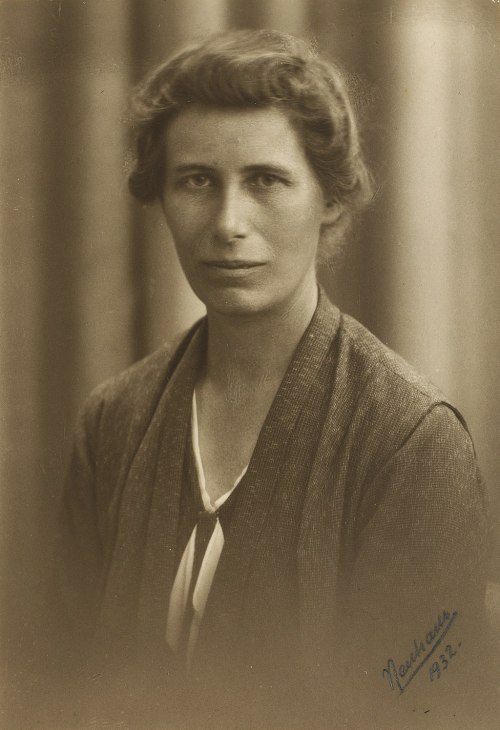
Inge Lehmann is our #23 installment of women of nuclear history. One of her discoveries would not have happened if not for nuclear underground explosions data.
Inge Lehmann (1888-1993) was a famous Danish geophysicist that discovered that the Earth’s inner core is solid (1936). Her second major breakthrough came thanks to data from underground nuclear explosions after she already retired from her full-time job in Denmark (1953). Inga correctly identified a presence of seismic discontinuity at depths between 190 – 250 km that was named after her: “Lehmann discontinuity”. She was called “The Grande Dame” of seismology.
- Inge Lehmann was born on May 13, 1888 in Osterbro, Denmark in a remarkable family: her father was a pioneer in experimental psychology, her grandfather laid out the first Danish telegraph line. Her family included barristers, politicians, engineers, priests, public leaders and activists in the women’s rights movement.
- In 1884, she was enrolled in a liberal and progressive co-educational school at Fællesskolen that offered identical curriculum for girls and boys, that was not typical in these times since girls were considered a weaker sex and not ready for intense studies. This school was led by Hanna Adler, Niels Bohr’s aunt.
- At age 18, Lehmann achieved a first rank mark in the entrance exam for Copenhagen University and started studies in mathematics, chemistry and physics (1907). She continued her studies in Cambridge, England (1910-1911), but since women were not allowed to use the library or work in the laboratories without a chaperone, she had a mental breakdown and went back to Denmark.
- Inge had good computational skills and worked in an actuary office before resuming her studies (1918); eventually she completed studies with a candidate magisterii degree in physical science and mathematics in 1920 at the age of 32.
- She broke her engagement in 1917, and decided never to marry since in that time it was hard as a woman to be married and pursue a scientific career.
- In 1925, Lehmann was assigned to be the assistant for Niels Erik Nørlund, a seismologist. In 1928, she was appointed as head of the Seismic Section at the Danish Geodetic Institute. She was overseeing the operation of three seismographic observatories, two of which were in Greenland.
- She noticed discrepancies in seismic data from the 1929 earthquake in New Zealand. The earthquake waves were showed in the locations that were considered “shadow areas” including Russian cities of Sverdlovsk and Irkutsk. Lehmann interpreted correctly that the P-waves arrival in these places was due to the reflections from the solid inner core, overturning existing theory of a completely liquid Earth’s core. She published her ground-breaking findings in a paper in 1936. According to her theory, the Earth consisted of 3 shells: the mantle, outer (liquid) core and inner (solid) core.
- Throughout the 1950s and 1960s, Lehmann traveled to North America. After her retirement from the Danish Geodetic Institute in 1952 at the age of 65, she joined the seismic research team at Lamont Geological Observatory in Palisades, New York and did some breakthrough work again thanks to using data from explosions of nuclear bombs during the cold war. This helped her prove the presence of a seismic discontinuity at depths between 190 and 250 km, called the “Lehmann discontinuity.”
- Inge published her last paper when she was 99 years old, and her 100th birthday was celebrated at the University of Copenhagen. She died on February 21, 1993 at the age of 104 in Copenhagen, Denmark.
- Inge Lehmann received international recognition in the second half of her life – among them the medal of the Seismological Society of America. She was awarded honorary doctorates from Columbia University in 1964 and from the University of Copenhagen in 1968, as well as numerous other honorific memberships. Because of her contribution to geological sciences, in 1996, the American Geophysical Union established the annual Inge Lehmann Medal to honor “outstanding contributions to the understanding of the structure, composition, and dynamics of the Earth’s mantle and core. The asteroid “5632 Ingelehmann” was named after her.
References:
https://en.wikipedia.org/wiki/Inge_Lehmann
Icons In Discovery: Inge Lehmann: https://www.youtube.com/watch?v=w2Tj-8FJFeY