“Women in Nuclear History” series #22 – Elizabeth Rona – Polonium Source Expert
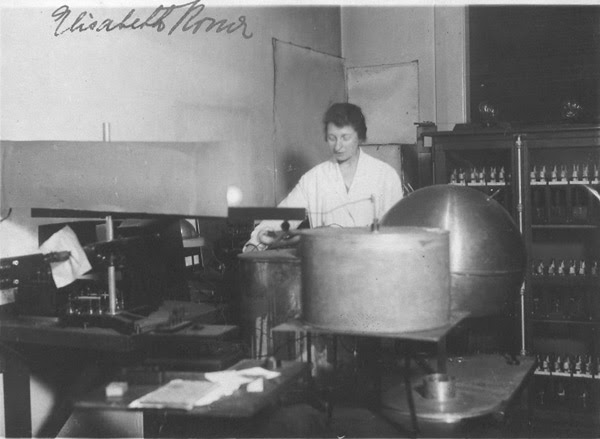
Elizabeth Rona (20 March 1890 – 27 July 1981) was a Hungarian nuclear chemist, known for her work with radioactive isotopes especially techniques to prepare polonium. She was also an expert in the radiometric dating and alpha irradiation. She was one of a few scientists who took seriously the harmful effects of radioactivity, therefore she lived until 91 and outlived many of her colleagues. She is our #22 installment in “Women in Nuclear.”
- Elizabeth Rona was born on March 20, 1890 in Budapest, Hungary. Her father, Samuel, was a doctor and one of the founders of the radium therapy and X-ray technology in medicine. He encouraged the education of his daughter, although he advised her to study science rather than becoming a medical doctor, since she as a woman – as a medical doctor she would face many difficulties.
- In 1912 Rona earned a PhD in organic chemistry from the University of Budapest. Then she worked at the university of Karlsruhe in Germany with Kasimir Fajans (Polish-American physicist) doing radiochemistry and radioisotopes studies.
- Rona worked under George von Hevesy, famous chemist and Nobel award winner after returning to Hungary. She completed her important work on the “diffusion constant of radon in water.” Rona also used radioactive tracers to detect how long it takes to diffuse depending on elements’ mass. She was set to isolate a new element “Uranium-Y”, but this element turned out to be thorium-231 radioisotope. She and Hevesy first coined the terms “isotope labels” and “tracers.” Elizabeth was the first woman to teach chemistry at the university level in Hungary in 1918.
- Due to riots after the 1st World War, the apartment she lived with her mother in Hungary was seized (1919). Owing to political instability and the so-called “white terror,” she resigned her position and left for Germany.
- Since 1921 Rona collaborated with the famous Otto Hahn (fission co-discoverer) in Berlin. She worked on separating “ionium”(now known as Th-230) from uranium.
- In 1924 Rona moved to Vienna and was employed at the Radium Institute under Stefan Mayer. Elizabeth learned how to use polonium rather than radium as an alpha source, because radium was very expensive. To improve her separation and purification techniques she visited Marie Curie’s Institute in Paris where she mainly worked with Irene Joliot-Curie (installment #3) and her group.
- Elizabeth Rona was also exploring a phenomenon of radioactivity in seawater, mainly in the island laboratory in Sweden with Berta Karlik (installment #12). They realized that there is a difference between radioactivity concentration in floating water compared to standing water that is settled on the seabed.
- Rona understood the dangers of radioactivity more than many other scientists in these times. While working in Vienna she wore protective mask, although Stefan Meyer, her boss, downplayed the hazards of exposure as well as a majority of the staff members at the Radium Institute in Paris. Rona became briefly sick after her visit at Marie Curie’s Institute, and she realized that this was caused by radioactive and chemical contamination there. In her book from 1978 Rona described the damage to bones, hands, and lungs caused by radioactive exposure.
- Rona was forced to move to the US in 1941, because of her Jewish origin. She provided technical information about polonium extraction to the Manhattan project. Originally she worked at Trinity College in Washington DC, then at Argonne National Laboratory and at Oak Ridge. She also designed a Frisch Grid ionization chamber used for alpha spectroscopy in Oak Ridge. After the war she was transferred to the University of Miami teaching at the Institute of Marine Sciences and continuing her work on geochronology. She found out that uranium levels are constant but thorium sinks to the sea floor.
- Elizabeth Rona died on July 27, 1981 at the age of 91 in Oak Ridge, Tennessee. She was posthumously inducted into the Tennessee Women’s Hall of Fame in 2015.
References:
- https://en.wikipedia.org/wiki/Elizabeth_Rona
- https://findingada.com/blog/2022/10/12/ald22-dr-elizabeth-rona-nuclear-chemist/
- https://massivesci.com/articles/elizabeth-rona-polonium-manhattan-project-argonne-oak-ridge-seawater-uranium-thorium-dating/
- https://lsc.org/news-and-social/news/celebrate-all-scientists-elizabeth-rona
- Roseanne Montillo, “Atomic Women: The Untold Stories of the Scientists Who Helped Create the Nuclear Bomb”; Little, Brown Books for Young Readers; Illustrated edition, 272 pages, May 19, 2020; ISBN: 031648959X; https://www.amazon.com/Atomic-Women-Stories-Scientists-Nuclear/dp/031648959X.
- Rona, Elizabeth (1978). How it came about: radioactivity, nuclear physics, atomic energy. Oak Ridge, Tennessee: Oak Ridge Associated Universities. ISBN 978-0-930-78003-6.