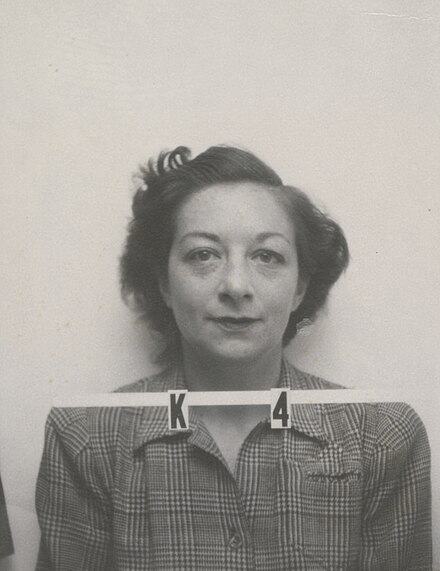
Charlotte Serber and her inspiring and also tragic story is our Women in Nuclear #19 installment.
Charlotte Serber (1911-1967) was the only female group leader during the Manhattan Project in Los Alamos Laboratory. She was instrumental to the success of the Manhattan project as the head of the Los Alamos Library Division.
- Charlotte Leof was born in Philadelphia, as the youngest of three children of Morris V. Leof, a physician. Her father was a member of the Socialist Party of America. They had famous and mainly liberal guests in their house including artists, journalists and scientists.
- She went to study at the University of Pennsylvania (1929-33) where she met Robert Serber, her future husband and a physicist. Later she worked as a freelance journalist, writing articles for newspapers, among them the Boston Globe, while her husband studied at Princeton University.
- They met Robert Oppenheimer at Michigan University, where Robert attended a summer school; he influenced them to move to the University of California in Berkeley. They became close friends with Oppenheimer and spent several summers at his New Mexico ranch. During that time Charlotte worked for the California State Relief Administration.
- In 1938 Robert Serber became a professor at the University of Illinois at Urbana–Champaign. Charlotte worked for the Office of Civilian Defense. She became active with the League of Women Voters. She shared left-wing views like the rest of her family, including her siblings, but she never joined the Communist Party.
- Oppenheimer asked Robert to join the Manhattan Project in 1942. Charlotte worked as a statistician first, then she joined the Manhattan project as a librarian in Los Alamos in January 1943. She was recruited as a librarian despite having no formal training, but this was considered an asset by Oppenheimer since this library had to be not stereotypical.
- She instituted the system of security passes, she also taught herself how to use the Dewey Decimal Classification. The library was started from scratch, eventually it had about 1,200 books and 50 scientific journals and a lot of classified materials. The library was divided into two parts: the main library and the technical report library. One of the library’s tasks was typing, copying and distributing highly classified reports. Eventually the library staff grew to 12 people, mainly women. Oppenheimer praised Serber’s work as a librarian.
- Serber was not permitted to view the Trinity Test – it was justified by a fact that the test site had no facilities for women. In 1946, Charlotte with eight other women wrote about their experiences at wartime Los Alamos. It was never published but donated to the Los Alamos Historical Museum.
- After the war Charlotte applied for a position as a librarian at the Radiation Laboratory in Berkeley, but she was rejected for lack of a security clearance; the likely reason was due to her political views. Unfortunately, Charlotte suffered the same scrutiny as Oppenheimer after the war – between 1946 and 1948, the FBI wiretapped her phone and was inspecting her mail.
- Charlotte was diagnosed with Parkinson disease and suffered from depression and took her own life with an overdose of sleeping pills on May 22, 1967 at the age of 56.
- In honor of Charlotte’s contributions, the National Security Research Center dedicated to her the room that houses the Classified Reports Collection. This room is known as the Charlotte Serber Center.